
Resurrection or Reset? Unpacking Kaizer Chiefs’ Data Ahead of the 2026/27 Campaign
Let’s not sugarcoat it: being a Kaizer Chiefs fan over the last decade has been a test of endurance. At the end of May 2026, there was potential for continuity under the co-coaching set-up of Khalil Ben Youssef and Cedric Kaze, but management decided to hit the reset button again.
With the 2026/27 season beginning this week, new coach Fernando Da Cruz takes the hot seat at Naturena. Da Cruz is no stranger to AmaKhosi fans as he briefly worked under former head coach Nasreddine Nabi as an assistant during the 2024/25 pre-season. Speaking of pre-season, Kaizer Chiefs have returned from their pre-season camp in Spain, where they drew 1-1 against Al-Kholood Club (Saudi Pro League) and lost 2-1 to La Liga side Elche. Yesterday they won the Toyota Cup by a scoreline of 1-0 against Scottland FC from Zimbabwe. Ahead of the upcoming 2026/27 campaign, Laduma Analytics dissects the data to objectively assess Kaizer Chiefs’ current standing.
Recent History
There was surprise yet also understanding amongst the fanbase, why the club let Khalil Ben Youssef and Cedric Kaze go at the end of their contracts. However, assessing their impact on Chiefs, one has to look at the state Chiefs were in when the duo inherited the team. In the 2023/24 season, Kaizer Chiefs finished in an embarrassing 10th position with 36 points. The following 2024/25 campaign was barely any better, yielding a 9th-place finish with 32 points from 28 league games (expulsion of Royal AM). Chiefs did, however, end their trophy drought by winning the Nedbank Cup. Missing the MTN 8 for the second consecutive year meant Amakhosi were letting themselves slide into mid-table mediocrity.
After some trouble with then coach Nasreddine Nabi, the two assistant coaches took the helm and, under their co-coach title, took the wheel for the remainder of the 2025/26 campaign. There were doubters, and there was skepticism; yet, what they achieved on paper was nothing short of a resurrection. They steered the club to an impressive 3rd-place finish, securing 54 points (the team’s second-highest points total since the 2019/20 season) and qualifying for the CAF Confederation Cup.
| Metric | 2023/24 | 2024/25 | 2025/26 |
| Shots Against | 342 | 273 | 248 |
| Shots Against (PG) | 11.4 | 9.75 | 8.27 |
| Goals Against | 30 | 32 | 19 |
| Goals Against (PG) | 1 | 1.14 | 0.63 |
| xGA | 30.73 | 28.79 | 20.57 |
| xGA (PG) | 1.02 | 1.03 | 0.69 |
| Clean Sheets | 12 | 7 | 17 |
The Defensive Lockdown
The primary driver behind the 2025/26 turnaround was their defensive organization. For years, Chiefs had been defensively fragile, conceding 30 goals in 2023/24 and 32 goals in 2024/25. Ben Youssef and Kaze worked hard in training to shut the back door. Under their watch, Chiefs conceded a mere 19 goals in 30 games. The difference – they nearly halved the 1.14 goals per game they shipped the season before.
This defensive solidity was built not only on reducing the sheer volume of shots but also, more importantly, the quality of opportunities the opposition was allowed to take.
- 2023/24: 342 shots against (11.4 per game)
- 2024/25: 273 shots against (9.75 per game)
- 2025/26: 248 shots against (8.27 per game)
By restricting the opposition on average to just over 8 shots per match, they took the pressure off Petersen. The result? A massive 17 clean sheets in 30 league games. To put that in perspective, they nearly kept more clean sheets in 2025/26 than they did in the 2023/24 (12) and 2024/25 (7) seasons combined (19 total).
Under the Engine
Skeptics will always argue about numbers and “the stats don’t tell you everything” etc, but the expected metrics prove that this team earned every single bit of their success. In the 2024/25 season, Chiefs underperformed their Expected Points (xPts) drastically, picking up only 32 actual points despite an xPts profile of 41.67. They were structurally better than their 9th-place finish suggested, but they lacked the coaching direction to put points on the board.
Ben Youssef and Kaze corrected this imbalance. In 2025/26, the team’s Expected Points stood at 52.84. The team actually overperformed this slightly to finish with 54 points. They didn’t fluke their way to 3rd place; they built a tactical framework that consistently generated high-value opportunities throughout the season. Their Expected Goals Against (xGA) was a phenomenal 20.57 (0.69 per game), meaning their defensive record of 19 goals conceded was entirely sustainable and aligned with the quality of chances they allowed.
| Season | Position | Points | Expected Points (xPts) | Goals | Expected Goals Against (xGA) | Shots Against (per game) |
| 2023/24 | 10th | 36 | 36.88 | 30 | 30.73 | 11.4 |
| 2024/25 | 9th | 32 | 41.67 | 32 | 28.79 | 9.75 |
| 2025/26 | 3rd | 54 | 52.84 | 19 | 20.57 | 8.27 |
Did They Deserve to Go?
Not really, no. Was it a mistake? We’ll never know really. Unless there were other elements behind the scenes that made keeping the co-coaches on untenable. Either way, taking a team from 9th to 3rd while recording the league’s second-best defensive record was an instrumental achievement. They took a squad devoid of confidence and made them incredibly hard to beat. It is no surprise that Durban City FC and Sekhukhune United, two aspiring clubs to challenge the big three, have split the duo and handed each of them a Head Coach contract. Their aim is the CAF qualification spots, which Chiefs will look to defend. How bizarre would it be if Chiefs don’t qualify and one of them does?
The Coaching Carousel
Kaizer Chiefs’ biggest enemy over the last decade hasn’t been Mamelodi Sundowns or Orlando Pirates – it has been their own lack of patience. The constant revolving door of coaches has made it impossible for any cohesive club philosophy to take shape. Every season, a new coach arrives and is given a mandate to perform. The style of play changes, different players are brought in, players are surplus to requirements and the cycle repeats. None of this, of course, is Da Cruz’s fault; the job is just two-fold pressure. Wake up a sleeping giant and keep a passionate fan base happy by playing attractive attacking football.
The data suggests that the coaches aren’t the only ones struggling to fulfil the mandate. The recruitment has been questionable at times. If you were to ask fans, what does the team miss, 99.9% would say a proven goalscorer. The team over the last few seasons has created a plethora of chances, yet nobody can finish.
The Scoring Crisis Reality
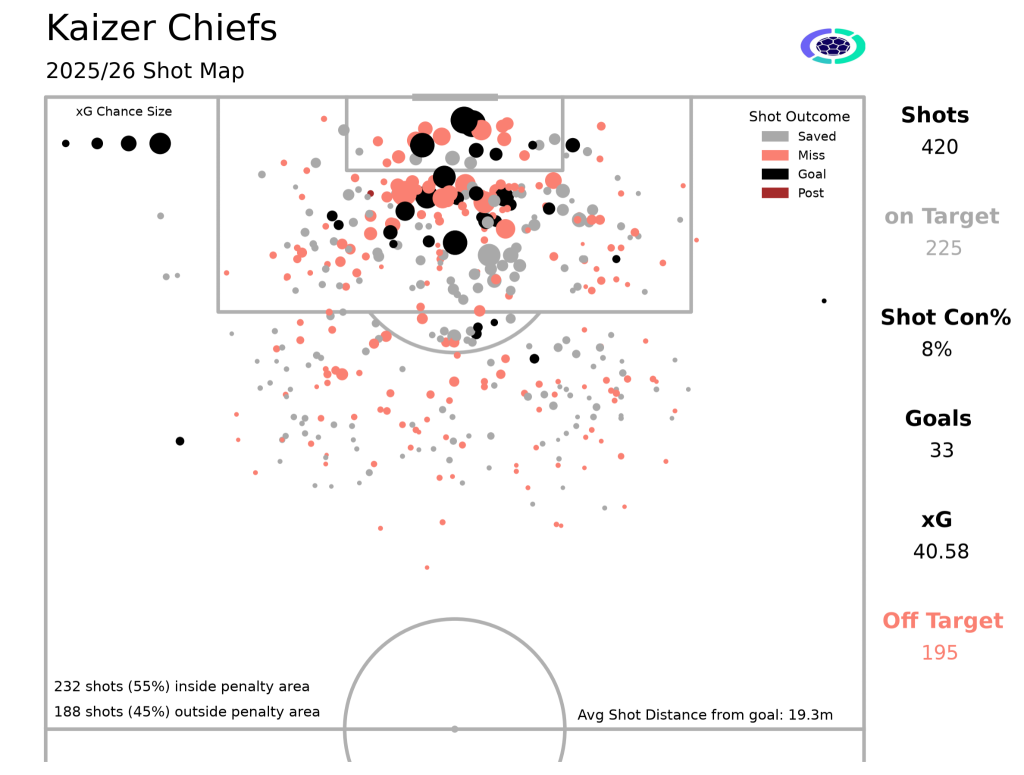
Expected Goals (xG) measures the quality of chances a team creates. If a team’s actual goals score is consistently lower than their xG, it is not a coaching issue – it is a player execution issue. The data shows that Chiefs have been wastefully throwing goal opportunities away for years:
- 2023/24 Season: their xG was 25.12, and they scored 25 goals. They finished exactly as expected, but the overall volume of chances created was dangerously low (just 30 big chances all season).
- 2024/25 Season: Under Nasreddine Nabi and a more expansive approach, the xG shot up to 35.27. Yet, they again only scored 25 goals, a massive underperformance of -10.27 goals. They created 59 big chances (2.11 per game) but simply could not find a calm head to finish them.
- 2025/26 Season: Under the co-coaches, Chiefs improved their chance creation even further, racking up a healthy xG of 40.58. However, they only scored 33 goals. Once again, they left 7.58 goals on the table.
Over the last two league campaigns, Kaizer Chiefs ‘should’ have scored roughly 76 goals based on the quality of opportunities created. Instead, they scored only 58. You cannot expect to win trophies or challenge for league honours when you are throwing away 18 goals due to poor composure in front of goal. In the meantime, your rivals have no issue and are scoring freely.
The Striker Issue
If we were to take a case study and examine why Chiefs struggled, we need to look no further than the lack of clinicality up front. Chiefs have struggled for a few seasons now for someone to score at least double-digit figures in a league campaign. Flavio Silva was the closest last season to anything they had in the previous five seasons. He was easily the most lethal and efficient forward at the club, scoring 8 league goals. Next up was Makabi Lilepo with 5 league goals.
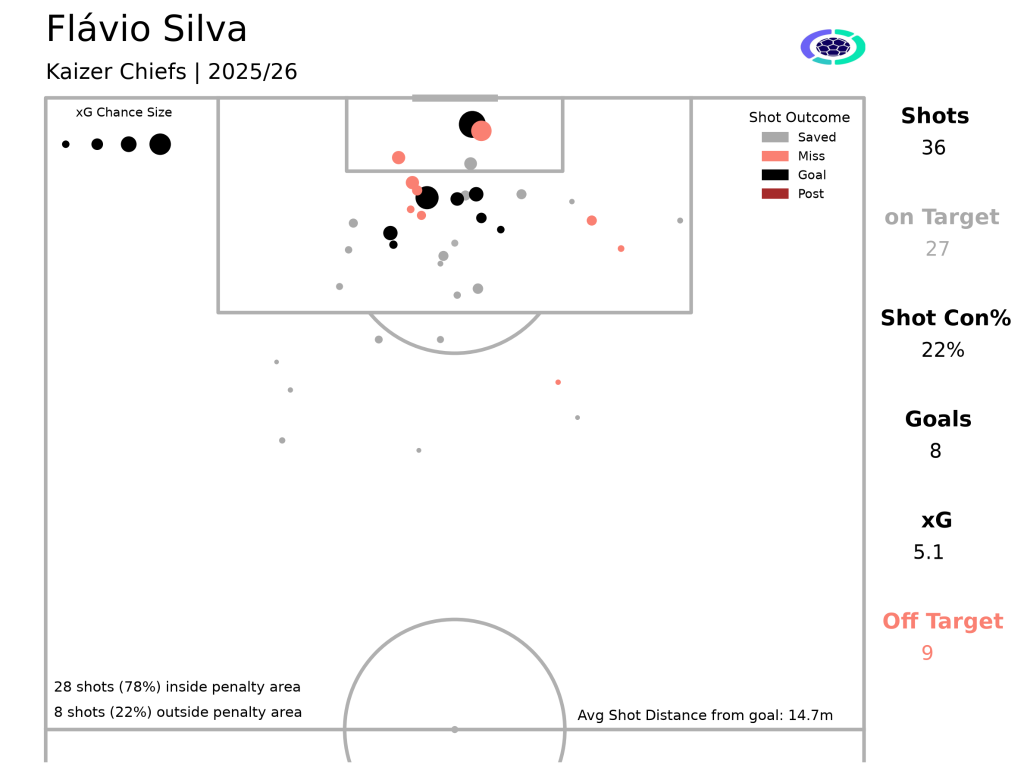
Silva made 22 league appearances, 13 starts and in just 1,112 minutes of league action scored 8 goals. He scored 3 goals over his individual xG of 5.04 and averaged a goal every 139 minutes. While their most clinical finisher sat on the bench, other players with far lower output were given game time.
The Over-Reliance on Makabi Lilepo
While Silva was starved of starting games, Makabi Lilepo, who featured on 27 occasions with 23 starts, scored five league goals. Lilepo was given total freedom to shoot, racking up a wild 88 shots over the course of the season. To put that into context, he took on average 3.76 shots per game, which turned out to be 10 shots higher than the next highest amount, which was Orlando Pirates, Oswin Appollis (78 shots).
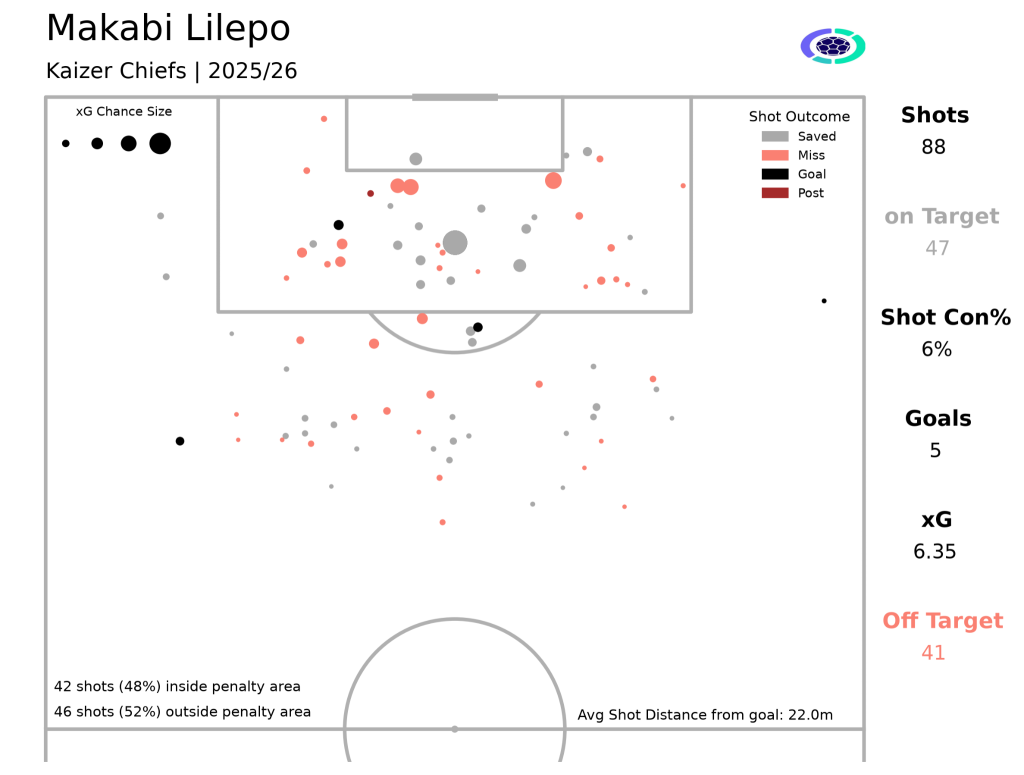
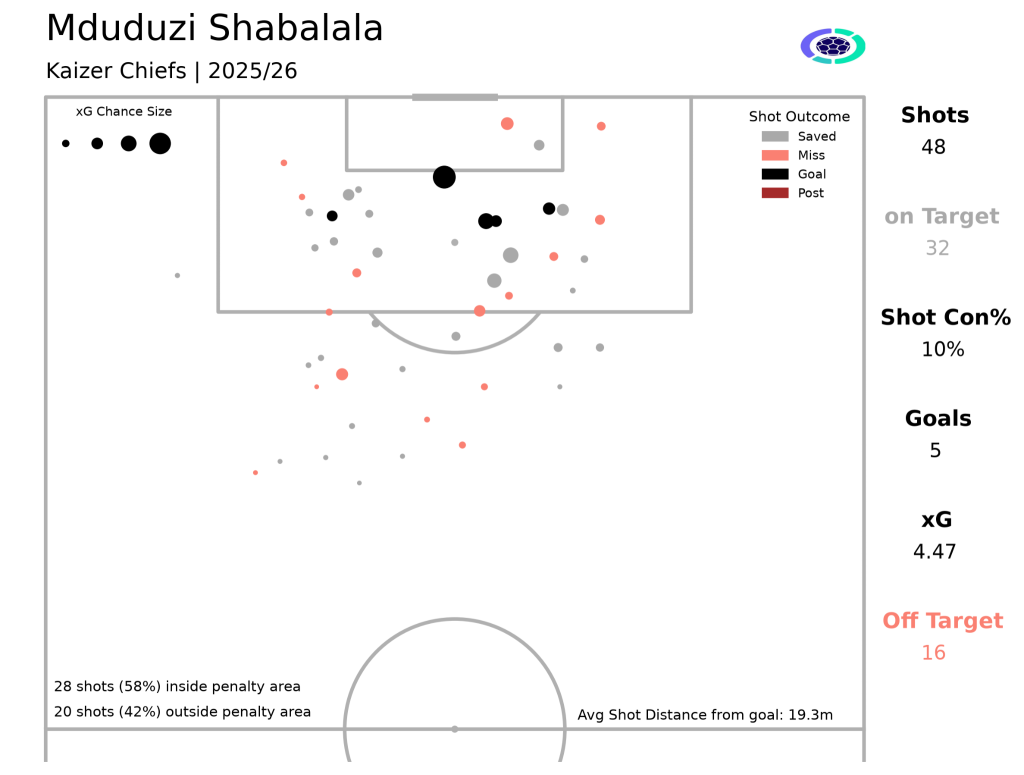
Lilepo slightly underperformed his xG of 6.35, finishing the campaign with a measly 5.68% goal conversion rate. This points to a failure of squad management and assembly, as well as in-game management. A club cannot afford to give a winger 88 shots to score 5 goals while their 8-goal striker sits on the bench with only 36 shots to his name. Whether Lilepo remains or moves on, replacing his volume of 88 shots with a similar or more efficient profile is vital for team success. How does DA Cruz look to replace his output? Mduduzi Shabalala was their next most reliable goal-scorer with 5 goals.
Unfortunately, as already mentioned, this is not a new issue for Chiefs – it’s a multi-year trend.
2025/26
We already discussed Makabi Lilepo. The fact that Khanyisa Mayo and Etiosa Ighodaro are not in the Top 10 list of shot takers for the season is worrying. The answer is simple, though. Regardless of Mayo being on loan at Chiefs last year, he made 10 appearances (430 minutes), scoring 2 goals off 1.53 xG, while Ighodaro made 4 appearances (224 minutes), scoring 0 off 1.11 xG. It’s not that they are bad strikers; the game time was incredibly limited for them. Should the question rather be – why were both not given more opportunities?
2026/27
Chiefs haven’t gone into the market for a striker (except for making Khanyisa Mayo’s loan permanent). Da Cruz must feel from what he has seen in pre-season that he can implement a system and strategy where he gets enough out of Silva, Ighodaro, Mayo and to a lesser extent Baartman and Jansen for the season ahead. Silva, Ighodaro and Mayo have shown in previous seasons and at different clubs that they can be clinical in front of goal, so there’s hope that they could do it again. However, when your primary attacking outlets consistently convert fewer than at least 12% of their opportunities, your team will always struggle to kill off games, no matter how good the manager’s tactical setup is.
Management Must Look in the Mirror
It is time for the Kaizer Chiefs board to take some responsibility. For the past decade, management has consistently used coaches as human shields to deflect from their own structural failures. If Fernando Da Cruz is to have any chance of succeeding where countless others have struggled (Middendorp, Hunt, Zwane, Baxter, Zwane, Ntseki, Nabi, Ben Youssef/Kaze), the board must change its behaviour. They need to move away from short-termism and instead commit to a multi-year project. More importantly, they must support Da Cruz and allow his team and tenure to mature. Until they do, the cycle will continue to repeat itself and another name may be added to the list above.
